

Search has never been a static discipline, but 2025 is shaping up to be the most disruptive year since Google first rolled out Panda and Penguin. Five new acronyms now dominate board-room conversations and Slack groups alike: AIO, AEO, GEO, SXO and LLMO. Mastering them will separate tomorrow’s search winners from companies still optimising only blue links.
In this deep-dive we will unpack what each term means, why it matters, and how forward-thinking marketers can integrate these approaches into an overall digital marketing strategy.
1. AIO – AI Optimisation
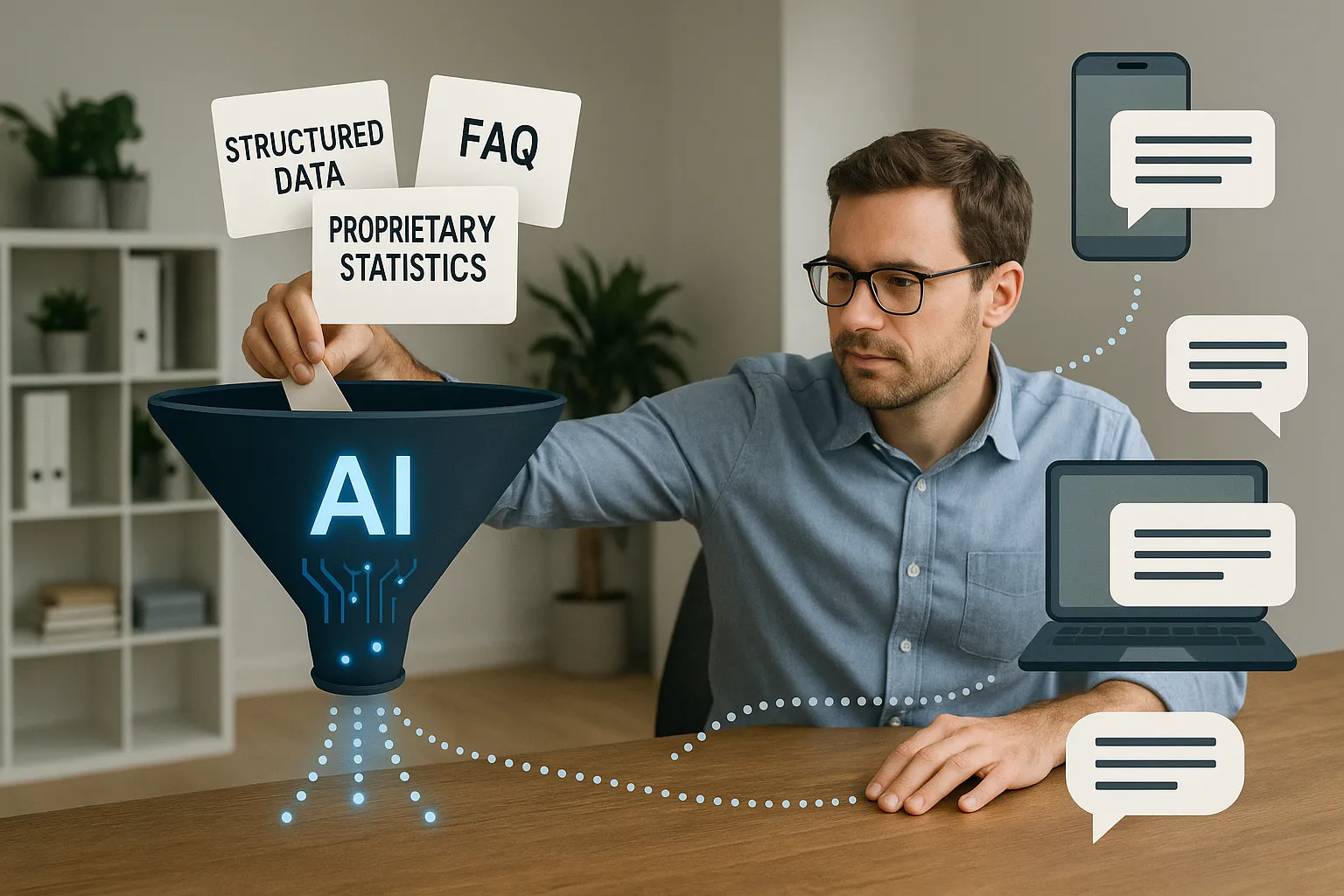
The rise of generative AI tools such as Google’s Search Generative Experience (SGE) and Microsoft Copilot means algorithms are increasingly co-creating content and summarising webpages for users. AI Optimisation (AIO) focuses on feeding these models with clean, structured, semantically-rich data so your brand is cited – or even quoted verbatim – inside AI answers.
Key actions for 2025:
- Mark up core content with Schema.org types beyond Article and Product. Recipes, FAQs, JobPosting, and MedicalEntity are already heavily used in SGE snippets.
- Maintain an updated, crawlable knowledge base (help hub, glossary, tutorial library) so large language models (LLMs) discover authoritative explanations straight from your domain.
- Use language that mirrors natural questions and answers. Tools like Google’s People Also Ask extractor can reveal the phrasing LLMs prefer.
2. AEO – Answer Engine Optimisation
Traditional SEO targets search engines; AEO targets answer engines: voice assistants, smart speakers, in-car infotainment and chatbots that surface a single spoken or text response. The zero-click nature of answer engines flips the funnel: brand visibility matters more than website traffic.
Steps to excel at AEO:
- Optimise for featured snippets and FAQ rich results, still the primary sources voice assistants pull from.
- Keep answers concise (40–55 words) and authoritative, citing reputable sources that bolster E-E-A-T.
- Local businesses should maintain pristine Google Business Profiles with up-to-date hours, services and high-resolution photos. Over 60 % of voice searches are location-based (Think with Google, 2024).
Want help polishing your local presence? Our dedicated team offers specialised local SEO services in Chennai that already incorporate AEO best practices.
3. GEO – Generative Engine Optimisation
Coined by SEO thought-leader Kevin Indig, GEO is the art of influencing how generative engines construct their long-form answers. While AIO is about being included, GEO is about owning the narrative inside AI overviews.
| GEO Lever | Practical Tactic | Outcome |
|---|---|---|
| Authoritative data | Publish proprietary statistics, reports or case studies (e.g., our [EV India SEO case study](https://www.gileaddigital.in/blog/ev-india-seo-case-study)) | LLMs cite unique numbers you originated |
| Multimodal assets | Provide image alt text and descriptive file names | AI image panels attribute visuals to you |
| Topical depth | Create clusters around niche subjects then interlink | Generative answers rely on your domain as a single-source expert |
Because generative engines weigh consensus, acquiring diverse backlinks remains essential. See our guide on nofollow, sponsored & UGC links for safe link-building tactics in an AI world.
4. SXO – Search Experience Optimisation
Google’s 2023 Helpful Content Update already prioritised user satisfaction signals such as dwell time and pogo-sticking. In 2025 SXO expands this philosophy beyond on-page UX to encompass post-click experience across channels.
- Core Web Vitals are table stakes, but interaction to next paint (INP) is now the decisive metric.
- Content must adapt to device context, think tap-to-call CTAs for smartphone visitors or embedded calendar links for smartwatch traffic.
- Personalisation engines should serve returning users updated modules rather than the same static blog post.
Implementing SXO often reveals technical roadblocks. Our development arm can audit site speed, build responsive modules and deploy AMP or PWA frameworks without sacrificing brand flair.
5. LLMO – Large Language Model Optimisation
With OpenAI partner browsing, Perplexity Pro, and ChatGPT plugins, content can bypass search engines entirely. LLMO involves crafting assets for ingestion by language models themselves, not just for indexing by crawlers.
- Offer datasets via public CSVs or APIs that models can cite.
- Use permissive licenses (CC BY) on certain articles to encourage dataset inclusion.
- Provide short declarative sentences preceding detailed paragraphs; LLMs often grab the opener for summaries.
How These Frameworks Work Together
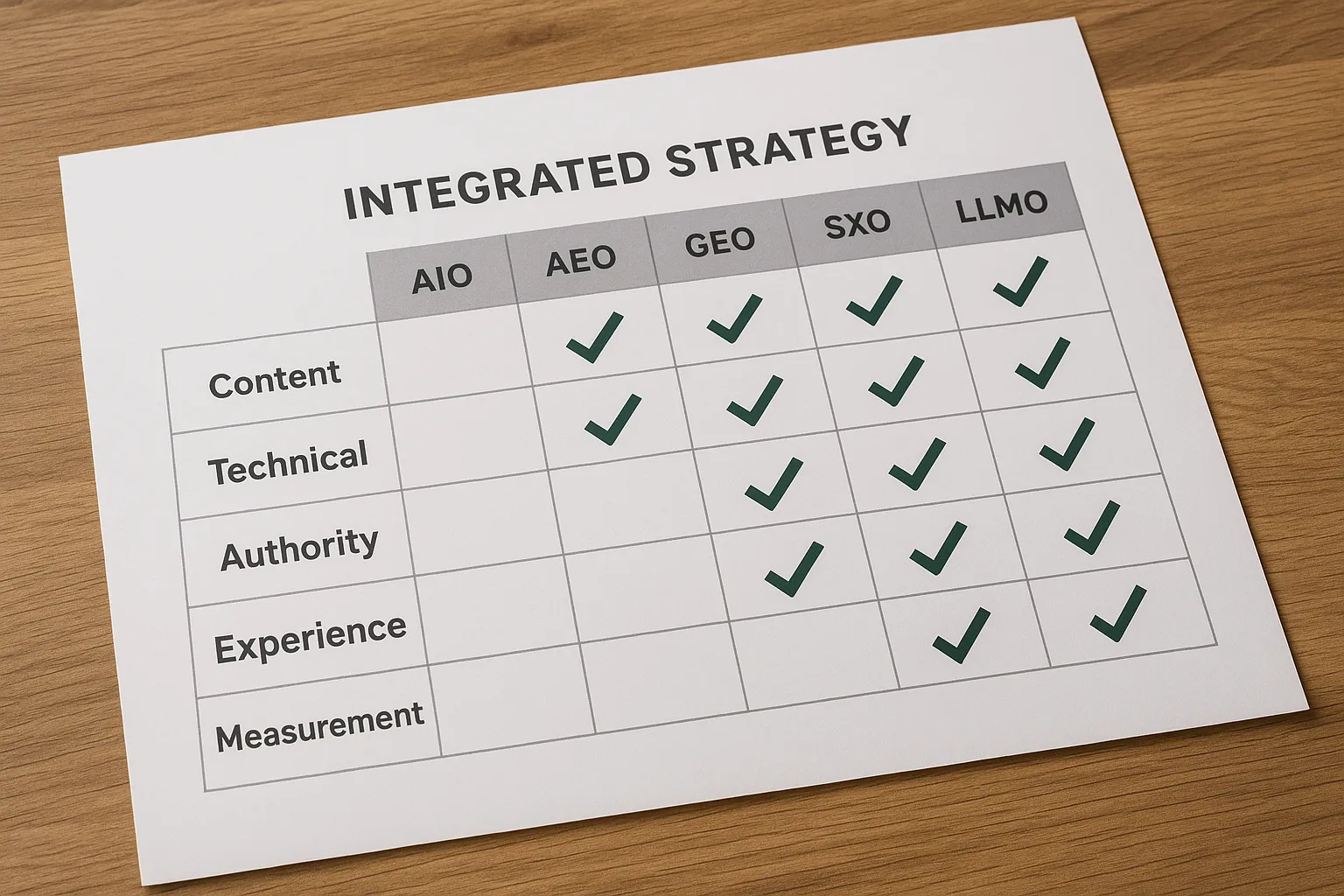
Although each acronym describes a slice of modern optimisation, their power compounds when orchestrated in a single roadmap:
- Keyword & Intent Research feeds AIO and AEO content briefs.
- Technical Mark-up & APIs push structured data for AIO and LLMO.
- Authority Building (PR, backlinks, case studies) underpins GEO.
- UX Engineering delivers SXO gains that in turn improve behavioural ranking factors for all organic opportunities.
At Gilead Digital we routinely run integrated sprints where content strategists, schema engineers, and UX developers collaborate. The result? Faster time-to-snippet, higher attribution rates inside SGE, and measurable lifts in assisted conversions.
Checklist: Preparing Your Site for 2025
- Map every service or product page to an answer-style FAQ block.
- Audit schema markup depth; enrich with
Author,Citation,ProsandConswhere applicable. - Create at least one proprietary dataset or industry report per quarter.
- Implement INP monitoring in Google Search Console and fix any lag >200 ms.
- Monitor AI overview coverage via tools like AlsoAsked or Oncrawl’s SGE visibility beta.
Frequently Asked Questions
Will classic SEO still matter in 2025? Absolutely. Crawlability, internal linking, and keyword targeting remain foundational. The new frameworks build on, not replace, core SEO.
How quickly can we see results from GEO or AIO efforts? Featured snippet wins can appear within weeks, but consistent citations in SGE usually take 2–3 months of consolidated content and link acquisition.
Do these optimisations require expensive AI tools? Some paid platforms help, yet many steps, like FAQ schema or performance tuning, can be implemented with open-source plugins and developer best practices.
Is it safe to open our data via public CSVs? Share aggregated, non-sensitive datasets. Doing so boosts your thought leadership while protecting customer privacy.
Ready to Future-Proof Your Search Strategy?
Whether you’re a Chennai start-up or an enterprise brand targeting global markets, Gilead Digital has the cross-functional talent to weave AIO, AEO, GEO, SXO and LLMO into a single growth engine.
• Book a complimentary audit: +91 90031 16482
• Or visit our service hub for end-to-end SEO solutions.
Bring us your toughest ranking challenge, we’ll show you the future of SEO, delivered today.